
How Particulate Scrubbers Work
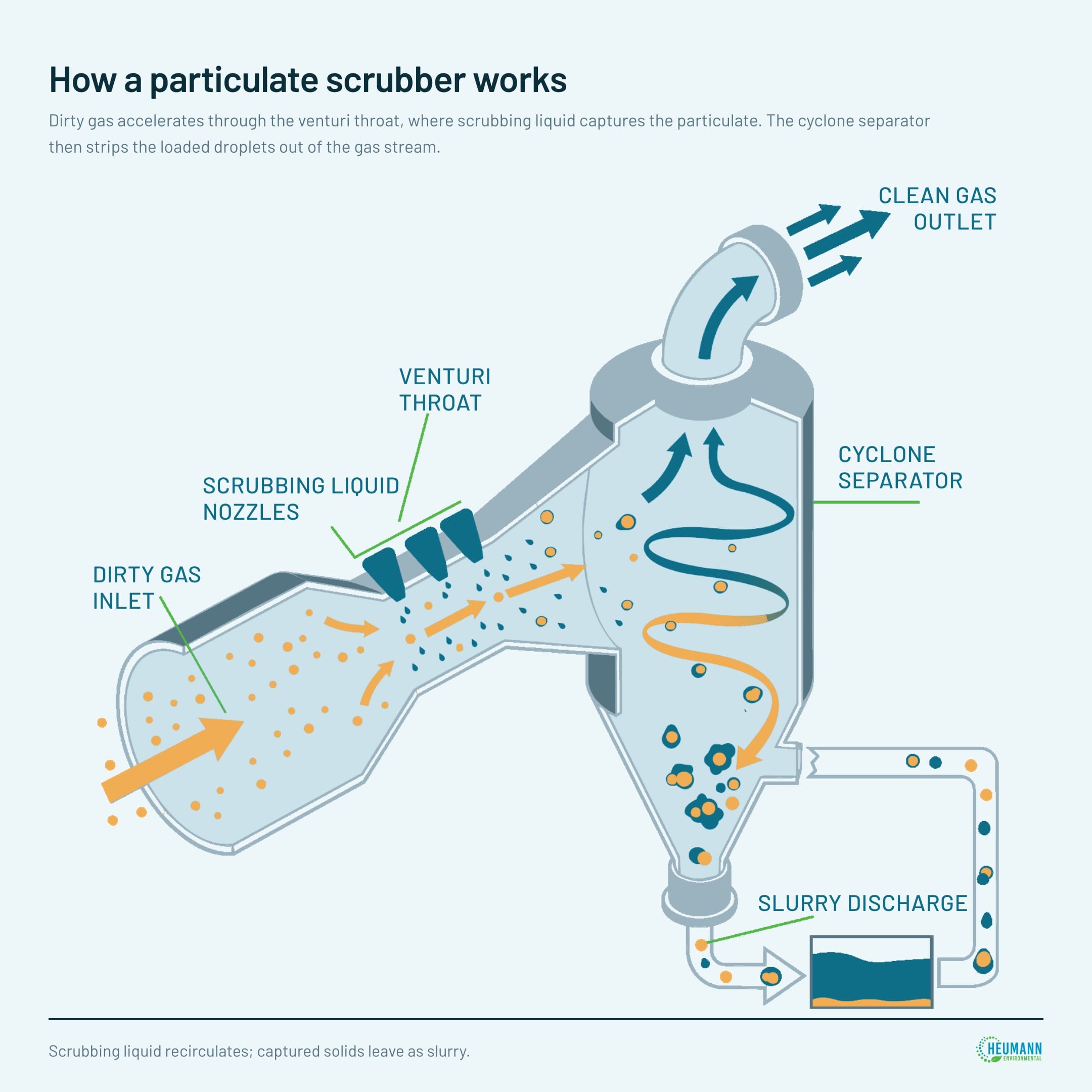
Wet scrubbers remove dust and fine particles from industrial exhaust by contacting the gas stream with water droplets that capture the particulate. The droplet–particle mixture then enters a separator, where the liquid is removed as slurry while clean gas exits the system. That separator is also usually what determines a scrubber system’s overall size and cost, which is exactly where our compact wet scrubber design changes the equation.
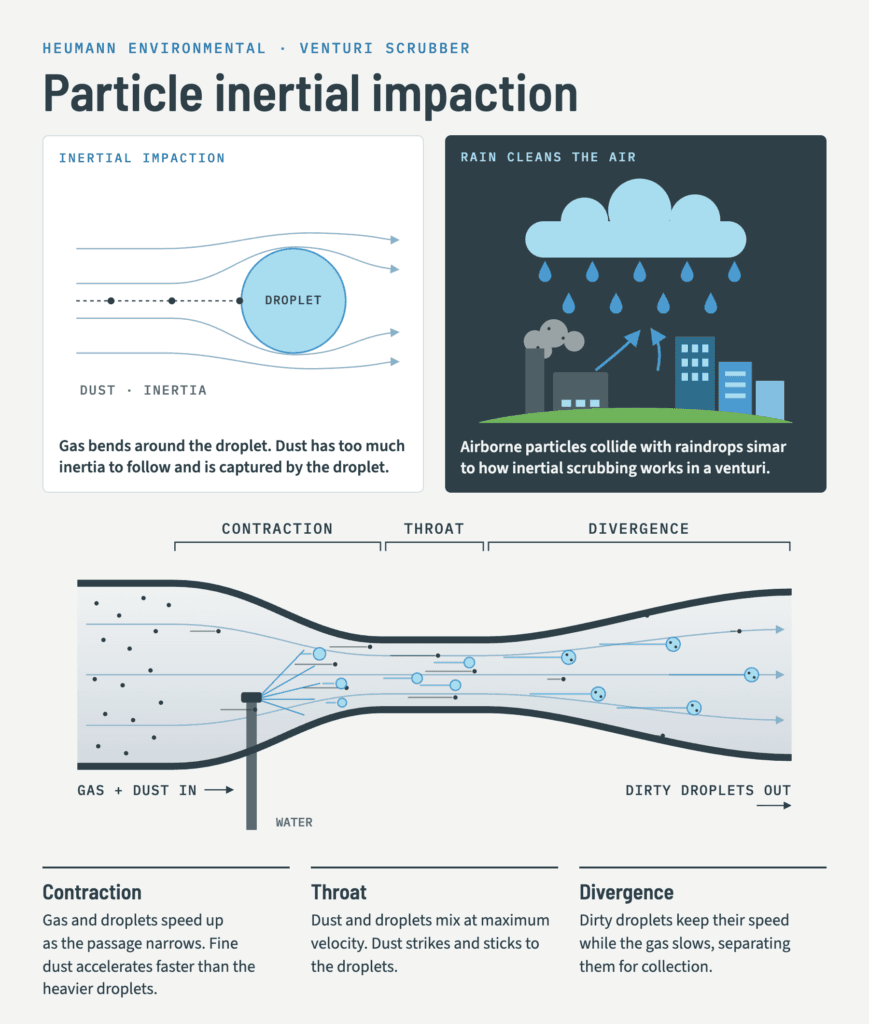
This process works by combining fine particles into larger, easily removed droplets, similar to how rain clears particulates from the atmosphere. This simple and effective approach has been widely used in industry for over a century due to its high collection efficiency.
How a Venturi Scrubber and Cyclonic Separator Work Together
Heumann Environmental primarily uses a venturi or adjustable wet scrubber design to maximize particulate capture. In a venturi scrubber, the gas stream accelerates through a contracting duct section where water is introduced. This acceleration causes dust particles to collide and attach to the water droplets.
In the diverging section that follows, the larger, now dust-laden droplets hold onto their velocity while any uncaptured fine dust slows with the surrounding gas. From the venturi, the gas and droplet mixture enters the cyclonic separator through a tangential inlet. That entry spins the flow into a vortex, and centrifugal force throws the water droplets outward to the separator wall, where they drain out while the cleaned gas continues through the outlet.
Advanced Particulate Scrubber Mechanics
Wet particulate scrubbers deliver exceptional removal efficiency and easy maintenance, ideal for industries like food manufacturing where sticky substances dominate. With our deep understanding of advanced scrubber mechanics, we provide the insights you need to optimize system performance and harness their versatility for your operations.

Applications
Why Heumann Particulate Scrubbers
Industries like food processing, metal dust handling, and agriculture choose wet scrubbers for their efficient removal of sticky, combustible, or hygroscopic materials, offering robust pollution control with minimal maintenance. However, optimizing scrubber performance requires precise calculations of pressure drop, water consumption, and spray pressure, along with effective instrumentation for water flow management.
Heumann Environmental leverages proprietary prediction models to ensure accurate performance, guaranteed capture efficiency, and compliance with emission standards. Our advanced performance prediction models ensure that our scrubbers meet specific emission limitations and maintain efficiency under various process conditions. We offer flexible, cost-effective solutions including control options, from manual to fully automated, to fit diverse needs and budgets.