
Why Compact Wet Scrubber Design Starts with the Cyclonic Separator
To reduce scrubber footprint, start with the system’s cyclonic separator. It’s usually the biggest driver of both size and cost. At Heumann Environmental (HEC), decades of hands-on engineering have gone into rethinking that component. It started when our founder’s mentor, Gerhard Miczek, first questioned the industry’s conservative velocity limits. That questioning became the foundation for a smaller, cheaper cyclonic separator, and a compact wet scrubber design.
This article explores the engineering insight behind that design and explains why it matters for facilities dealing with complex, multi-contaminant air streams.
The Venturi Contactor as A Versatile Starting Point
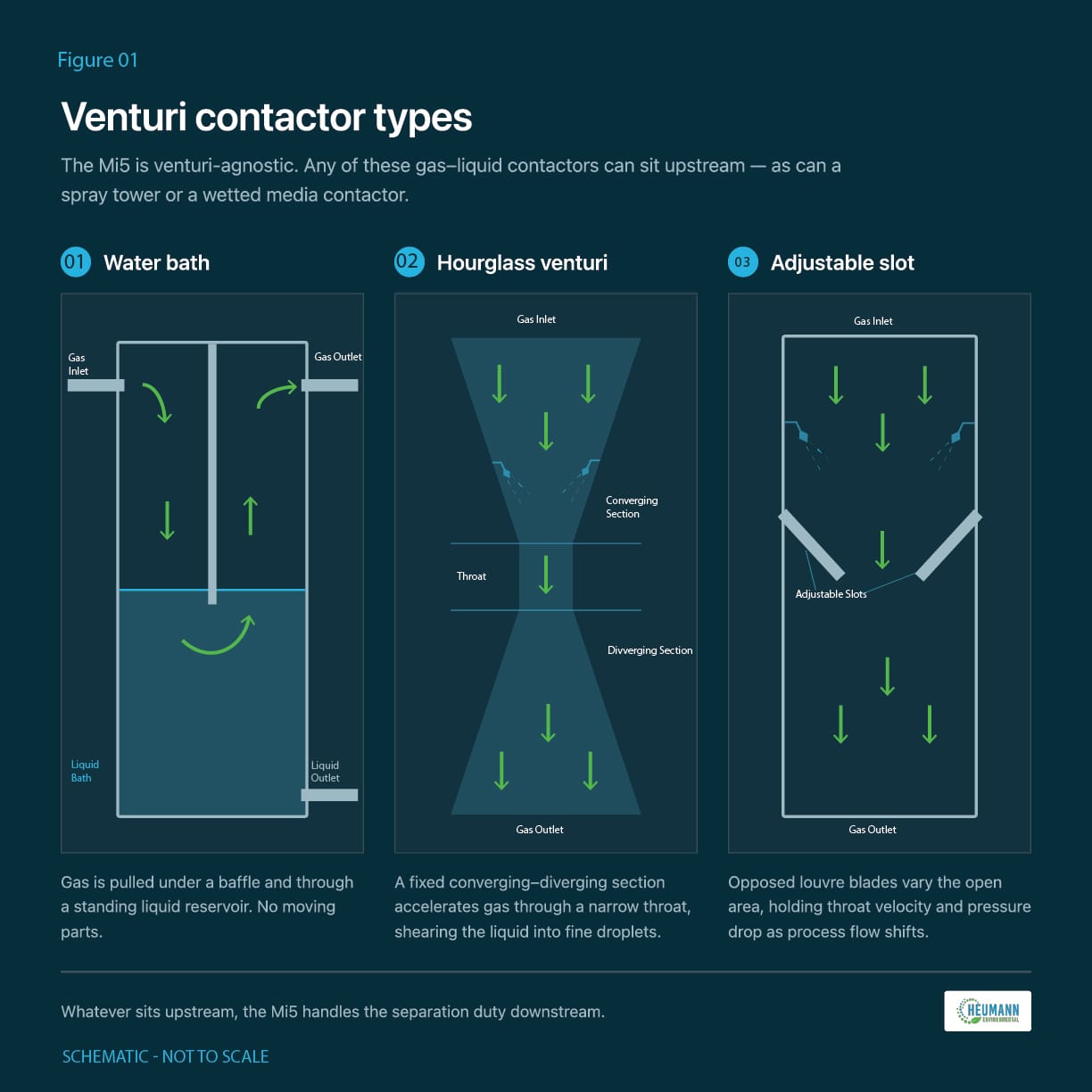
Wet scrubbers use a contactor stage to bring contaminated gas into direct contact with scrubbing liquid. At Heumann Environmental, we work with a range of venturi designs depending on the application:
- Water bath designs where gas is pulled under a baffle and through a liquid reservoir
- Traditional hourglass venturis that accelerate gas through a narrow throat
- Adjustable slot contactors as well as other adjustable configurations
The venturi itself is a well-understood technology. It can be engineered in many shapes and pressure drops (commonly 4-60 inches of water column) depending on particulate loading and removal targets. Our innovation isn’t in the contactor. It’s in what comes after it.
The Industry Standard: Big, Expensive, and Conservative
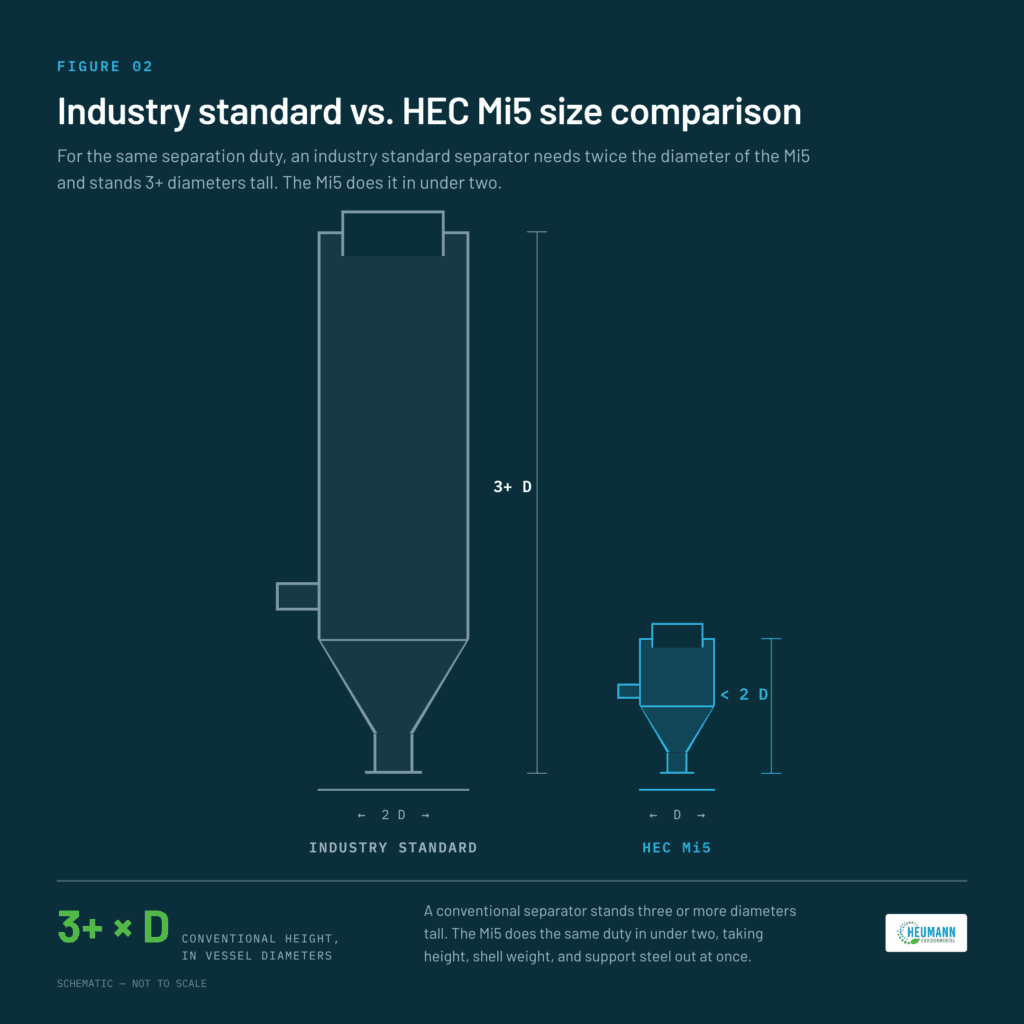
In conventional wet scrubber systems, the cyclonic separator is the component responsible for removing entrained liquid droplets from the cleaned gas stream before it exits to atmosphere. Industry-standard cyclonic separators are typically designed with:
- Axial velocity limited to 600 feet per minute
- Height of 3 or more diameters
- Cost representing up to 80% of the total scrubber system in some configurations
That last point is worth emphasizing. In a typical wet scrubber, the cyclone section, which is essentially just a cyclone acting as a liquid/gas separation device, dominates the cost. It drives a good deal of the overall footprint, the structural steel requirements, and the installation complexity. A smaller cyclonic separator allows us to reduce wet scrubber capital cost.
The Problem Nobody Solved
The 600 ft/min velocity limit became an industry standard not because someone proved it was optimal, but because systems designed above that speed would “spit” liquid out of the separator. When that happened, engineers simply made the cyclone bigger or slowed the gas down.
The air pollution control industry developed many of its designs through trial and error. People figured out what didn’t work by making mistakes, but they rarely took the time to understand why those designs were failing. The 600 ft/min limit Miczek observed, was essentially a workaround masquerading as a design rule.
The real question was: What’s actually causing liquid carryover at higher velocities, and can it be solved without simply making the separator larger?
Miczek’s Engineering Breakthrough
Rather than accepting the 600 ft/min ceiling, Miczek studied the actual mechanisms of liquid re-entrainment and developed specific techniques to prevent it. The separator relies on the same tangential gas entry that drives our dry high-efficiency cyclones, spinning the incoming gas into a vortex that throws liquid droplets outward to the wall. From there, gravity carries the liquid down to the drain while the gas continues spinning upward through the vessel, exiting through the outlet at the top. The result is a high velocity droplet separator that runs reliably at roughly double the velocity conventional separators are designed around.
Key performance characteristics of the HEC Mi5 design:
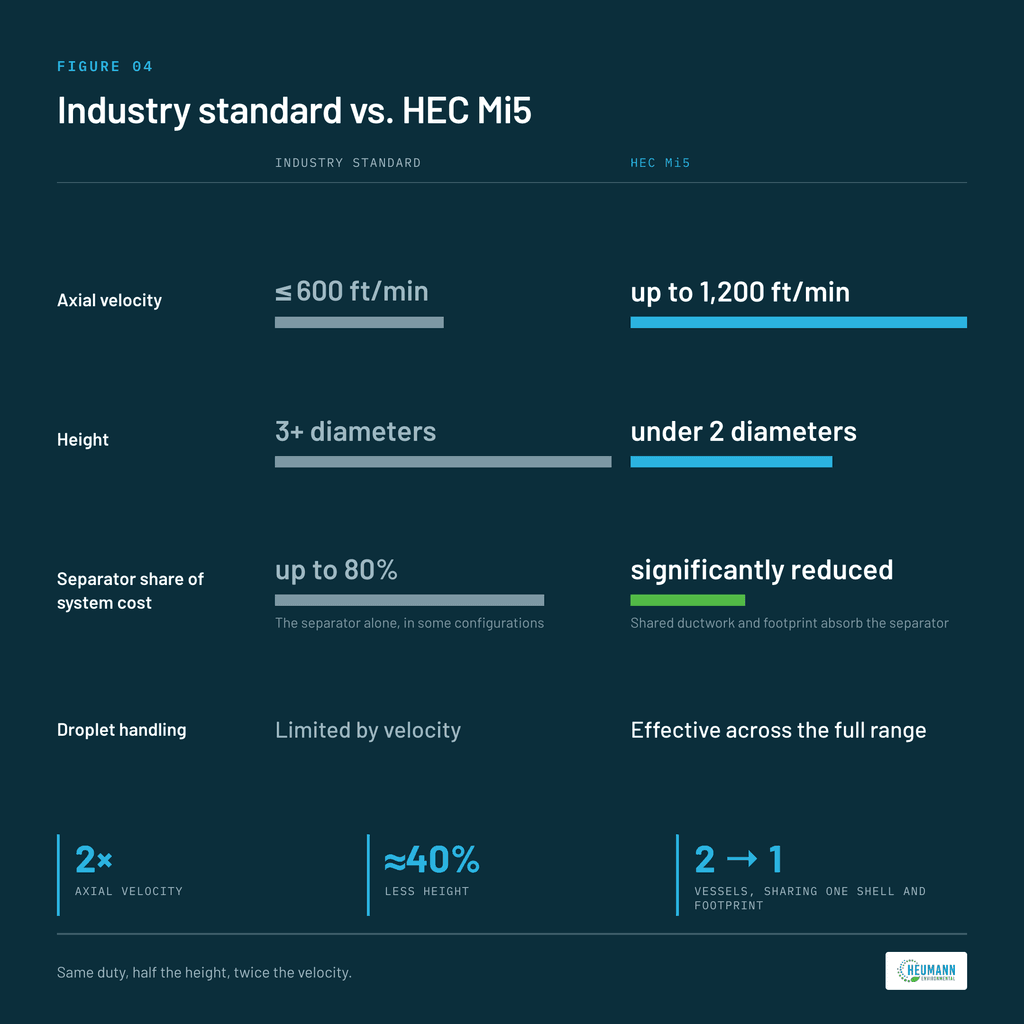
We’ve tested these separators at velocities even above 1,200 ft/min, though we limit production designs to that threshold as a practical margin of safety. The smaller diameter that results from higher velocity also means less material, less weight, and less structural support, lower shipping costs, and less fabrication labor required.
The Payoff Is a Stacked, Compact wet scrubber design
The real magic of a smaller cyclonic separator shows up in system architecture. When you’re dealing with complex air streams containing multiple contaminants (for example, particulate matter combined with acid gases), a conventional approach requires:
- A venturi scrubber for particulate removal
- Ductwork connecting to a cyclonic separator
- More ductwork connecting to a packed tower for gas absorption
- Each component on its own foundation with its own structural support
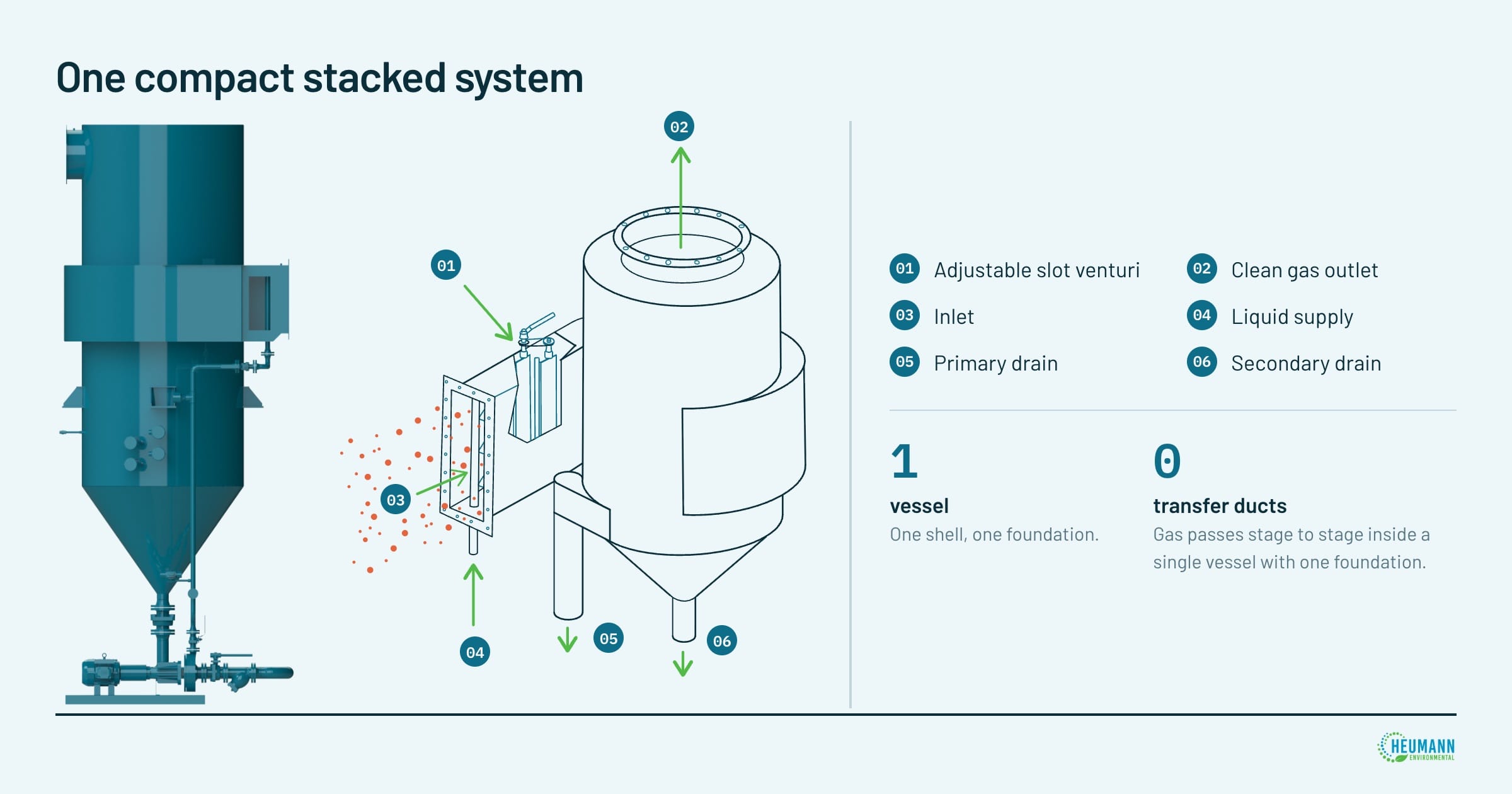
With our compact cyclonic separator, we can combine the venturi, separator, and packed tower into a single system. Gas enters the venturi contactor, where liquid is injected to begin particulate capture. It continues into the cyclonic separator, entering tangentially at the base of the vessel. The gas vortex spirals up through the separator and from there it passes up into the packed tower stacked directly above, where clean gas exits at the top. Meanwhile the liquid carrying the contaminant drains out through the primary and secondary drains at the bottom.
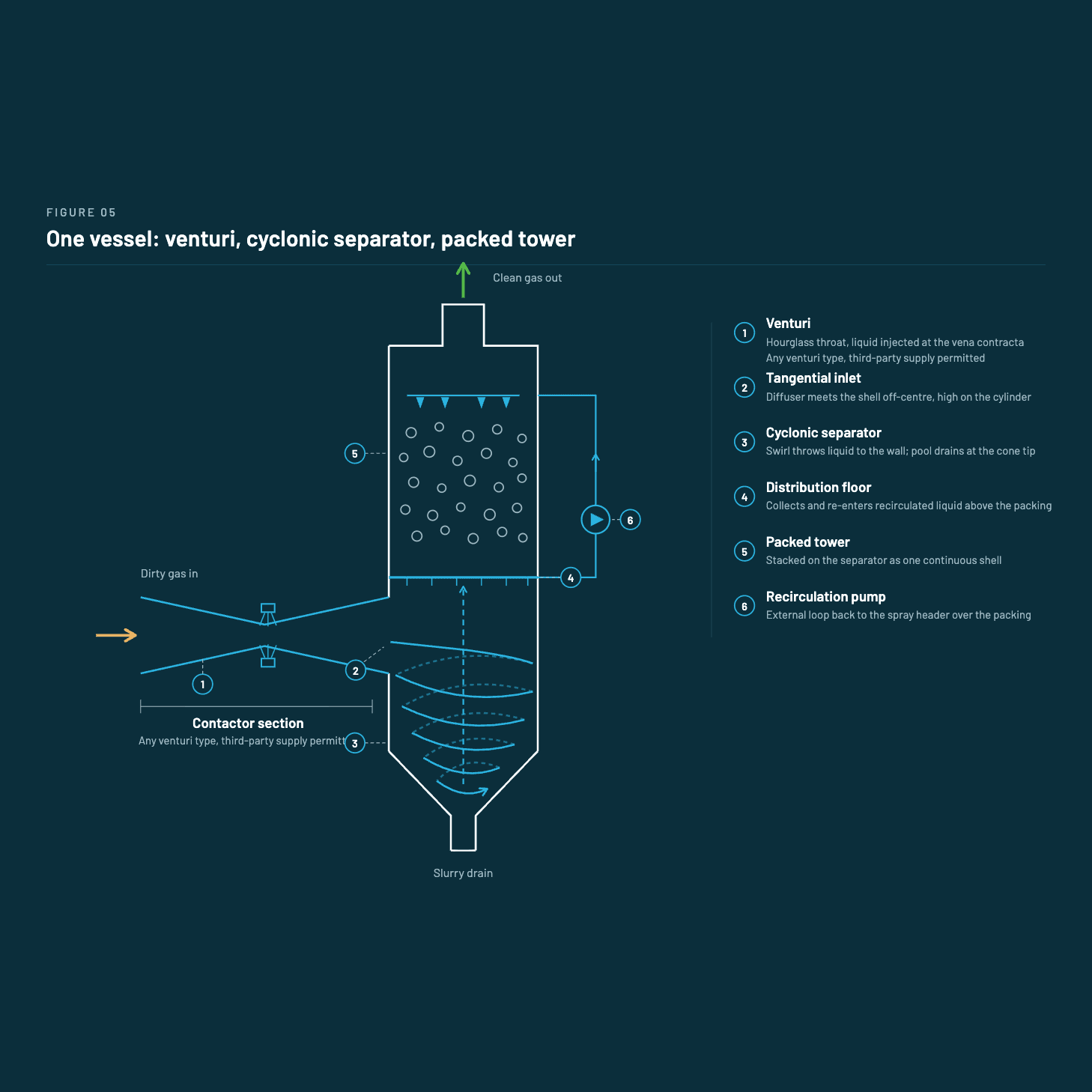
That single vessel wet scrubber system reduces the ductwork that would otherwise connect three separate components, along with the separate foundations and field-assembled transitions each one would need on its own. It also cuts pressure losses across the whole system, since gas never travels through an external duct run, which can lower fan energy costs.
Versatility and Compatibility
Importantly, our cyclonic separator technology is venturi-agnostic. It doesn’t dictate or constrain the contactor design upstream of it. Whether a facility uses our venturi designs, a spray tower, a wetted media contactor, or a third-party proprietary design, our separator can be integrated to reduce the overall system footprint.
This makes the technology valuable even for partners or competitors with their own contactor IP. The separator is modular and improves any wet scrubber system it’s paired with.
Applications
The Mi5 compact wet scrubber design applies across a wide range of industrial air pollution control systems, including:
- Particulate removal systems
- Acid gas scrubbing systems
- Multi-contaminant exhaust treatment
- High-pressure-drop venturi scrubbers
- Retrofit scrubber installations
- Space-constrained industrial facilities
- Compact packaged scrubber systems
- Integrated venturi and packed tower systems
It’s especially useful anywhere a process needs both particulate control and gas absorption, but separate vessels and ductwork would cost more or take up more room than a facility can spare.
One single, elegant package
By questioning a decades-old industry assumption and engineering a real solution to liquid carryover, Heumann Environmental has created scrubber systems that are half the height, dramatically less expensive, and far easier to install than conventional alternatives. For facilities with tight space constraints, multiple contaminants, or budget pressure, our compact cyclonic separator technology turns what used to require two or three separate pieces of equipment into a single, elegant package. Every Heumann particulate scrubber we build starts from this same design, custom-engineered to the specifics of each project.